Our History
Our History
Our History
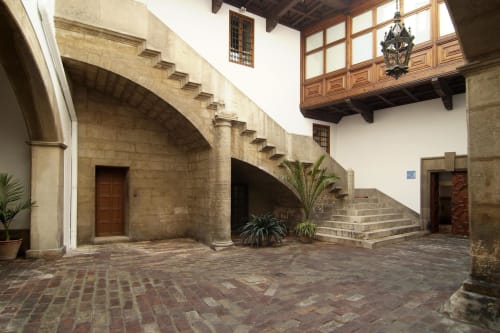
Some facts about the history of the house
The earliest records mentioning this house date from the first half of the 16th century, when it was inhabited by Pascual Perpiñá, a notary to the aristocracy and the high clergy. He was so highly regarded that the street bore his name for more than two hundred years. His residence was a medieval building with a two-flight staircase characteristic of Valencian Gothic architecture. Pascual Perpiñá modernized the house by adding an extraordinary studio on the mezzanine level—what we would call an office today—featuring Renaissance-style ceilings with small plaster vaults richly decorated with ornamental designs.
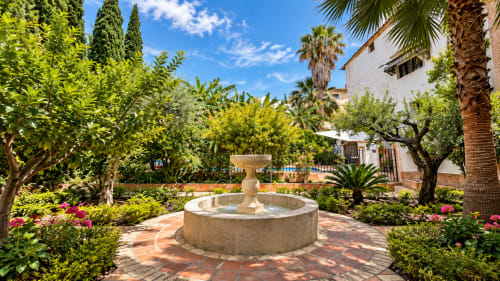
At the beginning of the 17th century, the house passed into the hands of the Cebrià family, who lived in it for at least five generations and over two hundred years. An important episode took place during the War of the Spanish Succession in 1707, when Félix Cebrián, the fourth-generation owner of the house, was temporarily living in Valencia. He held several important public jobs in the city and, after declaring himself—as all his relatives—a supporter of the Bourbon cause, he was exiled from Valencia by the Austrian faction. They looted his house in Xàtiva and took his two sons prisoner: José, who held a doctorate in law, and Félix, a canon of the collegiate church. In 1712, the elder son became heir, but he renounced his rights in favor of his brother because he was unable to compensate him for the investment made to restore the property. Thus, Canon Félix Cebrián became the consolidated owner, and in time the street took his name.
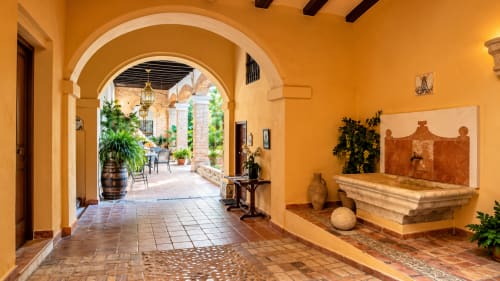
The house still preserves the fountain and pond mentioned in a document from 1620, although the fountain likely had running water from the early 15th century. Also of great interest is the collection of doors from different periods and styles, though perhaps not all original to the house. Particularly noteworthy are some 16th-century designs following the models of the Italian architect Sebastiano Serlio, which were highly appreciated by the city’s elite at the time. Other doors date from the second third of the 18th century, with rectangular and square panels, while some others are less antique, in the style and period of Carlos IV.
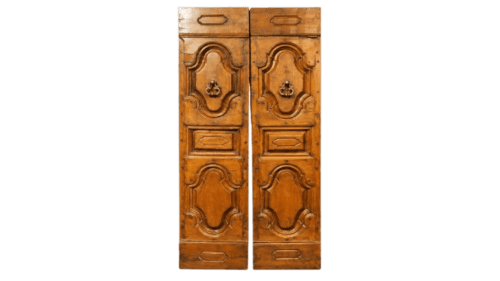
Late 18th-century doors in the style of Carlos IV.
Door from the second third of the 18th century.
From September 2022 to March 2024, the necessary renovations were carried out to open the Rural House for tourist rental. Each bedroom now has its own private bathroom for guests’ use.
The Trinity. Ceramic panel from the first half of the 19th century.